
Get found by your target audience.
Organised the way search engines already read the web — as topic clusters. Each pillar is the definitive read; each spoke drills into a single decision.
SEO Fundamentals
Rank for the phrases your buyers actually convert on. Crawlability, on-page, keywords, backlinks, Core Web Vitals — in plain English.

SEO in 2026: the complete plain-English guide
Everything that still matters in modern SEO — from crawlability and on-page to buyer-intent keywords, backlinks, and Core Web Vitals — with no jargon.

Crawlability checklist: 10 issues that hide your best pages
Robots.txt, canonicals, sitemaps, orphan pages, redirect chains — the crawl problems that silently cost you rankings.

On-page SEO: the only checklist you need
Title, meta, headings, internal links, schema — the on-page basics that still move rankings in 2026.

Intent beats volume: pick keywords buyers actually convert on
A 200-volume commercial keyword out-earns a 10,000-volume informational one every time. Here's how to spot the difference.

Keyword difficulty explained: when to fight, when to flank
Difficulty scores are directional, not destiny. Learn when a low-DR site can still rank on a ‘hard’ term.

Core Web Vitals in one page
LCP, INP, CLS — what each one measures, what causes it, and the one fix that helps most.

Internal linking: the free ranking boost most teams skip
How to move authority from your strongest pages to the ones that actually need it.

Backlinks in 2026: what still moves the needle
Guest posts are dead. Digital PR, unlinked mentions, and directory placements are alive and well.

A technical SEO audit you can do in under 30 minutes
The 12 checks that catch 90% of real issues — without a paid crawler.

The content refresh playbook that beats writing new posts
80% of your traffic gains hide inside pages you already have. Here's how to unlock them.

Measuring SEO success without lying to yourself
The four metrics that actually matter — and the vanity ones you should stop reporting.
Answer Engine Optimization
Own the featured snippet, the People Also Ask box, and the AI overview. Be the answer, not another blue link.

Answer Engine Optimization: the complete guide
How to win featured snippets, People Also Ask, and AI overviews — and why AEO now beats classic SEO for many queries.

The four featured snippet formats (and how to win each)
Paragraph, list, table, video — each has a formula. Match the format and you win the box.

People Also Ask: the goldmine hiding under every SERP
PAA boxes surface the exact questions your buyers are asking. Here's how to turn each into a section.

FAQ schema done right (and where teams get it wrong)
The rules Google enforces, the mistakes that get you demoted, and a paste-ready template.

AEO vs SEO: what changes and what stays the same
AEO doesn't replace SEO — it stacks on top. Here's exactly which practices carry over.

Google AI Overviews: what they cite and how you get in
AI Overviews rewrite the SERP. Here's the pattern behind the sources they choose.

Voice search optimization in one page
Voice answers usually come from featured snippets. Optimize for one, you get the other.

The structured data types that still earn rich results in 2026
Google has quietly deprecated several rich result types. Here's what still works.

How to write a paragraph that wins the answer box
A formula for the 40–60 word answer that gets you into position zero.

3 AEO content templates you can steal today
Question-post, comparison table, and definition — the three formats that consistently earn boxes.

How to track AEO performance without a fancy tool
Search Console filters, a spreadsheet, and 20 minutes a week.
Generative Engine Optimization
Make your site quotable to ChatGPT, Perplexity, Gemini and Copilot. Bot access, llms.txt, extractability, entity signals.

Generative Engine Optimization: the complete guide
How to make your site quotable to ChatGPT, Perplexity, Gemini, and Copilot — from bot access to entity signals.

llms.txt explained: the robots.txt for generative AI
What llms.txt is, why every site should have one, and a paste-ready starter template.

AI bot access: who to allow, who to block
GPTBot, PerplexityBot, Google-Extended, Claude, and more — a per-bot decision matrix.

Making content extractable: the anti-JavaScript checklist
AI models crawl HTML, not React. Here's how to keep your best content in reach.

Entity signals: teaching AI who you are
Organization schema, sameAs, consistent naming — the signals that make models confident enough to cite you.

How to structure content for AI extraction
Short paragraphs, real lists, real tables, obvious headings — the shape LLMs prefer.

Freshness signals for generative AI
Models discount stale content. Here's how to prove your page is current.

GEO vs AEO vs SEO: how they stack
Three acronyms, one funnel. Here's how each layer feeds the next.

Auditing your GEO score in 15 minutes
A checklist you can run against any site to spot GEO gaps fast.

5 GEO mistakes killing your AI citations
The most common self-inflicted GEO wounds and the one-line fix for each.

Writing for both humans and LLMs
You don't need to choose. The shape that works for models is the shape skimmers already prefer.
AI Citation Tracking
Know when AI engines mention your brand — and when they cite your competitor instead. Prompts, sentiment, share of voice.

AI citation tracking: the complete guide
What to track, why it matters, and how to turn every AI mention (or miss) into a content brief.

How to find the prompts your buyers actually ask AI
Stop guessing. Here are 5 ways to pull real prompts your category is being asked about right now.

Share of voice in AI answers: the metric that replaces rank tracking
Position 1 is meaningless if the answer is a summary. Here's the new scoreboard.

Why Perplexity cites some sites and not others
Perplexity is the most transparent AI engine about its sources. Here's what earns the citation.

How ChatGPT decides what to cite
GPTBot crawling, retrieval, and the two ways your brand ends up in an answer.

Sentiment in AI answers: neutral is the new negative
‘X is a project management tool’ is worse than ‘X is a project management tool loved by remote teams’.

When AI cites your competitor but not you: the fix
A 4-step playbook for reclaiming a prompt owned by a rival.

How to get cited on the authority sites AI actually reads
Wikipedia, G2, Capterra, industry wikis — the citation ladder that feeds every major model.

Different prompts for different buyer stages
Awareness, consideration, decision — each stage has its own prompt patterns. Cover all three.

Measuring AI referrals to your site
Perplexity, ChatGPT, and Copilot are already sending clicks. Here's how to see them in GA4.

A 20-minute weekly routine for AI citation health
The exact ritual we recommend to keep your CiteRank™ climbing week over week.
Buyer Intent SEO
Attract buyers, not tire-kickers. Which keywords actually convert, why intent beats volume, and how to build pages buyers land on ready to purchase.

Buyer intent SEO: the complete guide to attracting buyers, not tire-kickers
Why intent beats volume, the four intent types every marketer must know, and the exact keyword patterns that put buyers on your page ready to purchase.
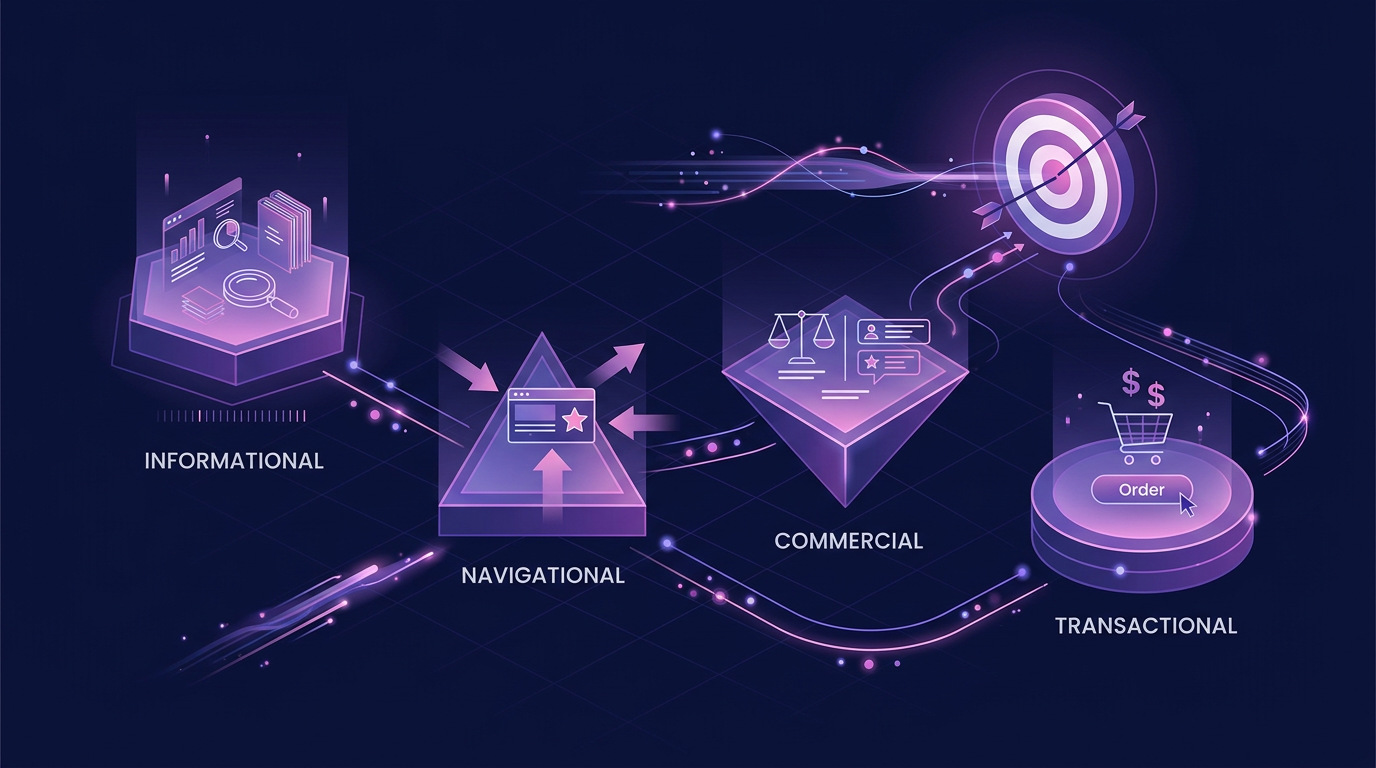
Transactional vs commercial vs informational vs navigational intent, explained
The four search intent types with real examples, typical conversion rates, and which one to target for revenue.

How to spot buyer-intent keywords in 30 seconds
A 30-second checklist to tell whether a keyword will bring buyers or browsers — before you spend a day writing.

Why 1,000 informational visitors lose to 20 transactional ones
A worked example showing why raw traffic is a vanity metric — and how to run the same math on your own site.

Bottom-of-funnel keyword patterns that convert
12 keyword patterns that consistently deliver buyers — with examples from SaaS, ecommerce, and services.

The 40 modifier words that signal buyer intent
A copy-paste list of the modifier words that turn any keyword into a commercial or transactional query.

'Best', 'vs', 'alternative': how to rank for comparison keywords
The exact page structure that ranks — and converts — for comparison keywords in SaaS, ecommerce, and services.
![Local buyer intent: 'near me' and 'in [city]' patterns](/api/public/blog-image/local-buyer-intent-near-me-and-in-city-patterns.png)
Local buyer intent: 'near me' and 'in [city]' patterns
How local buyer-intent keywords work, what Google shows for them, and how to structure a page that ranks and converts.

Long-tail keywords that outperform short-tail for revenue
Why 4+ word keywords convert 3–5× better than short-tail — and how to find the ones with real search volume.

How to turn an informational post into a buyer-intent page
A 6-step teardown that converts your best-traffic, worst-converting article into a page buyers act on.

Intent mismatch: the #1 reason pages don't convert
When Google's SERP tells one story and your page tells another, conversion collapses. Here's how to diagnose and fix it.
Growth Channels Playbook
Where your target audience already hangs out — directories, Reddit, YouTube, podcasts, LinkedIn, Wikipedia — and how to get seen and cited on each.

The growth channels playbook: where to get seen by buyers in 2026
The 10 channels that reliably put brands in front of buyers today — with realistic effort, cost, and citation value for each.

Directory listings that still drive buyers (and which to skip)
The 12 directories worth submitting to in 2026 — plus the 30+ that waste your time.

Reddit for B2B: how to get cited without getting banned
Reddit is the #1 domain cited by ChatGPT for product recommendations. Here's how to earn those mentions without a shadowban.

YouTube for AI citations: why video transcripts get quoted
YouTube transcripts are indexed by Google and pulled into AI answers. Here's how to structure a video so the quote lands on your channel.

Podcast guesting: the underrated backlink and citation channel
One podcast appearance can deliver a backlink, an AI-quotable transcript, and a lead pipeline — for less effort than a blog post.

LinkedIn thought leadership that ChatGPT actually cites
How to write LinkedIn posts that build authority AND get quoted by AI engines — not just liked and forgotten.

Guest posting in 2026: what still works
Guest posting isn't dead — but the 2015 playbook is. Here's what earns quality backlinks and real buyer traffic today.

HARO / Qwoted / Featured: earning citations from real journalists
How to answer journalist queries in a way that lands the citation — with a template that works 30% of the time.

Wikipedia and Wikidata: the citation goldmine most brands ignore
Wikipedia and Wikidata are the highest-weighted sources in AI training data. Here's how to earn a legitimate presence — no paid editing.

Substack, Medium, and syndication: rules of engagement
How to use third-party publishing platforms to reach new audiences without hurting your own site's SEO.

Community-led growth: Discord, Slack, Circle — measured right
How to run a community that actually drives revenue — with the three metrics that separate real communities from vanity Discords.
Ready to see where you're invisible?
Run your first RocketRank™ audit in under two minutes — no card, 150 free tokens.