
Buyer intent SEO: the complete guide to attracting buyers, not tire-kickers
Why intent beats volume, the four intent types every marketer must know, and the exact keyword patterns that put buyers on your page ready to purchase.
- → Transactional vs commercial vs informational vs navigational intent, explained
- → How to spot buyer-intent keywords in 30 seconds
- → Why 1,000 informational visitors lose to 20 transactional ones
- → Bottom-of-funnel keyword patterns that convert
- → The 40 modifier words that signal buyer intent
- → 'Best', 'vs', 'alternative': how to rank for comparison keywords
- → Local buyer intent: 'near me' and 'in [city]' patterns
- → Long-tail keywords that outperform short-tail for revenue
- → How to turn an informational post into a buyer-intent page
- → Intent mismatch: the #1 reason pages don't convert
Buyer intent SEO targets keywords whose searchers are already in a buying mindset. A page ranking #3 for a transactional keyword typically converts 10–30× better than a page ranking #1 for an informational one — even though the informational page gets far more traffic.
Buyer intent SEO: The practice of choosing, writing for, and structuring pages around keywords whose search intent is commercial or transactional — so the visitors who arrive are already deciding what to buy, not just researching a topic.
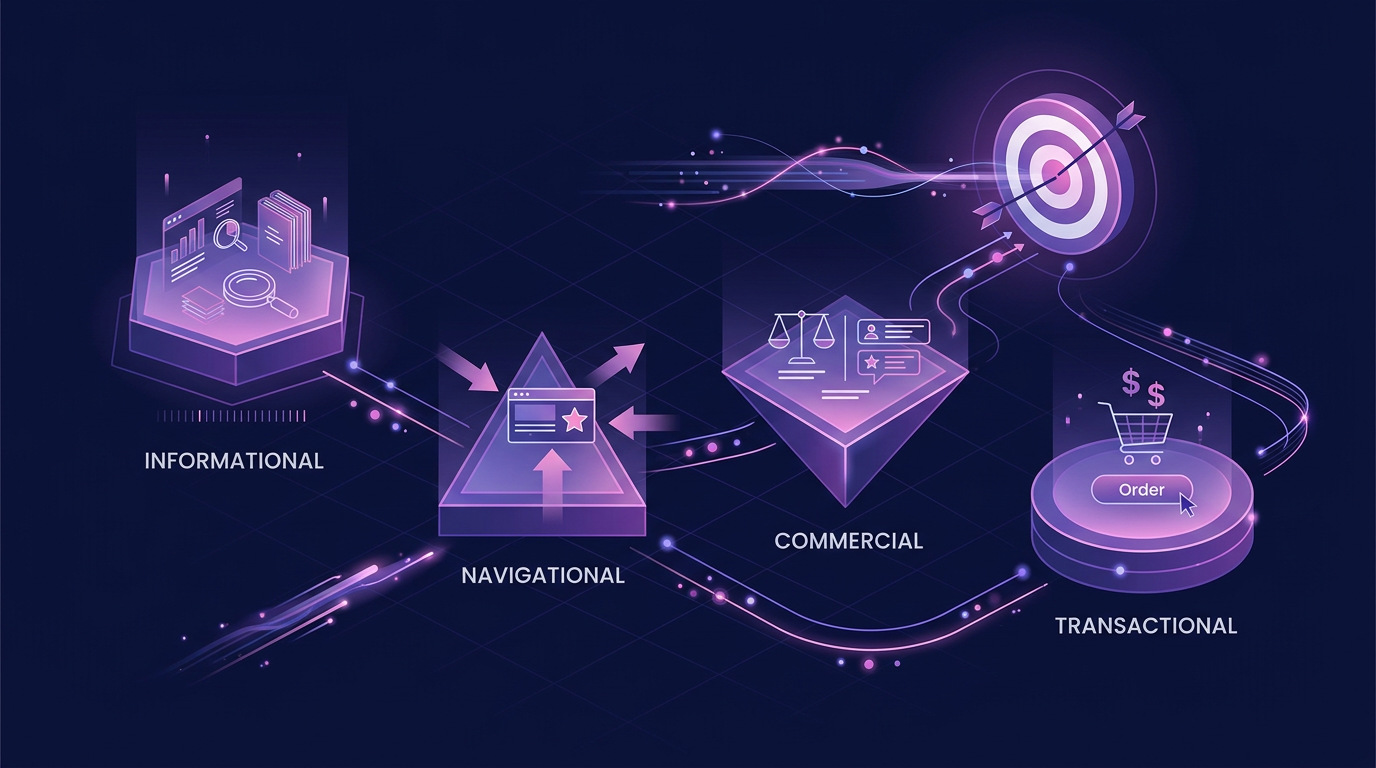
- There are four search intent types: informational, navigational, commercial, and transactional.
- Only commercial and transactional intent reliably produce revenue.
- Transactional keywords convert at 5–15% on average; informational keywords convert at 0.2–1%.
- The words 'best', 'vs', 'alternative', 'price', 'buy', 'near me', and 'for' signal commercial or transactional intent.
- Long-tail keywords (4+ words) carry buyer intent more often than short-tail keywords.
- Google's SERP layout reveals intent: shopping results and comparison tables mean commercial; forum results mean informational.
The four search intent types
Informational intent
The searcher wants to learn something. Example: 'what is content marketing'. High volume, low conversion. Useful for building authority and topical coverage, but not for revenue on its own.
Navigational intent
The searcher wants a specific site or product. Example: 'webapp rocket login'. High conversion for the brand named, zero opportunity for anyone else.
Commercial intent
The searcher is comparing options before buying. Example: 'best crm for small business'. Moderate volume, high conversion. This is where most buyer-intent SEO wins live.
Transactional intent
The searcher is ready to act — buy, sign up, book, download. Example: 'buy running shoes size 10'. Lower volume, highest conversion.
Why intent beats volume
A page ranking #1 for a 10,000-searches-per-month informational keyword might get 3,000 visits and 15 conversions. A page ranking #3 for a 400-searches-per-month transactional keyword gets 60 visits and 6 conversions. Same effort, 40% of the revenue — from 2% of the traffic. Volume without intent is a vanity metric.
How to spot buyer intent in a keyword
- Look for modifier words: best, top, review, vs, alternative, cheap, price, cost, buy, order, book, hire, near me.
- Check the SERP: shopping carousels, price snippets, and comparison lists mean Google reads it as commercial or transactional.
- Check the CPC: keywords advertisers bid $5+ on almost always carry buyer intent.
- Read the People Also Ask box — if the questions are 'how do I choose' or 'which is best', intent is commercial.
The buyer-intent content template
- Lead with the recommendation, not the backstory. Buyers scan.
- Use a comparison table when the query includes 'vs', 'best', or 'alternatives'.
- Put pricing above the fold when the query includes 'cost' or 'price'.
- End with a single, unambiguous next step — no 'learn more' links to other blog posts.
Put this into practice
Run a RocketRank™ audit and see exactly where you're invisible — and the one-click fix for each finding.